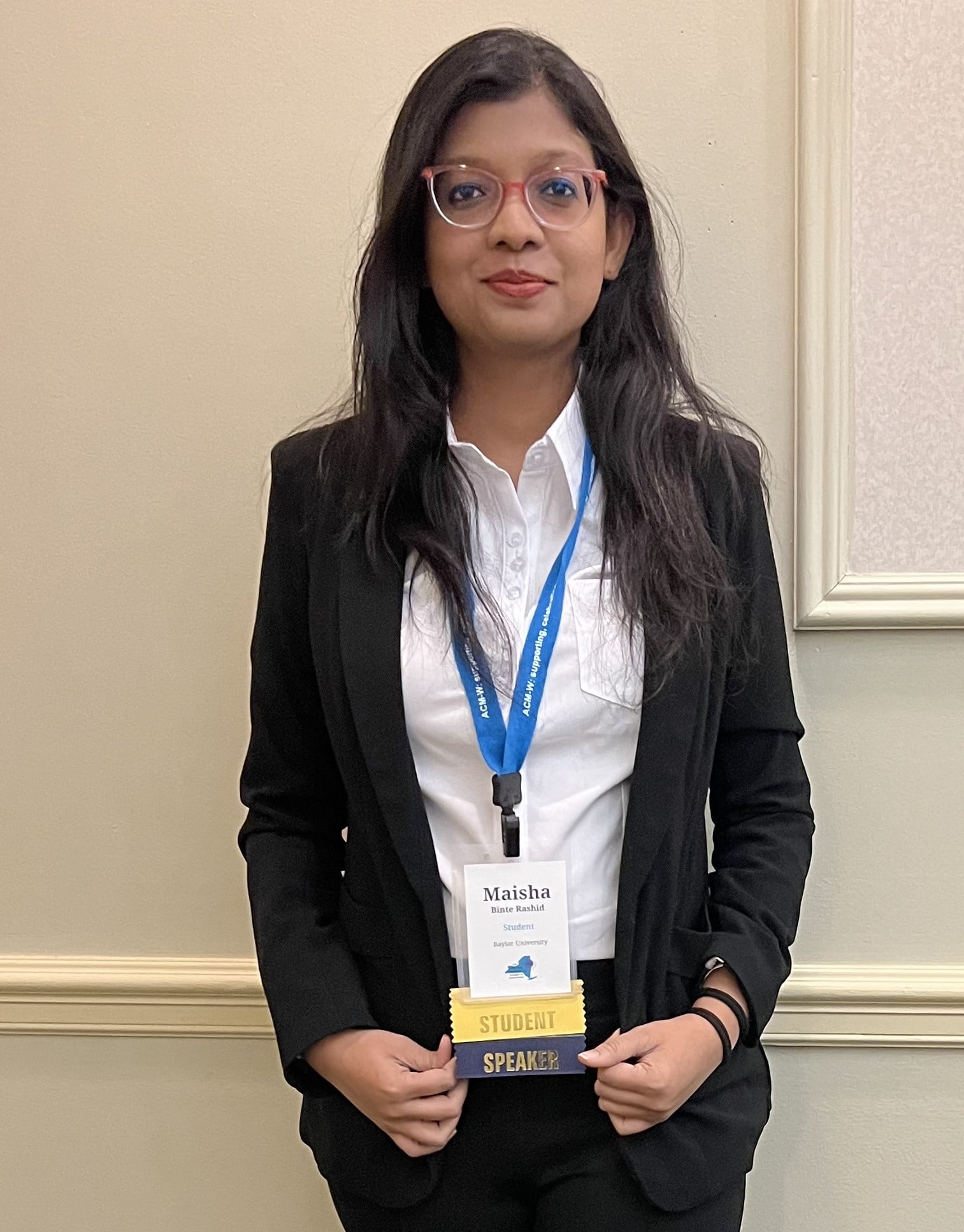
Ph.D. Candidate, Computer Science, Baylor University
Welcome! My name is Maisha and I am a Ph.D. candidate in Computer Science at Baylor University, where I am advised by Pablo Rivas. I am part of the Rivas Lab, specializing in multimodal machine learning and AI robustness. My research focuses on integrating text and image data to defend against adversarial attacks, with particular expertise in large-scale language models (LLMs), natural language processing, and deep learning.
As a Graduate Research Assistant, I have contributed to NSF-funded projects and enhanced AI safety for models like GPT-2 and Vision Transformer. My work includes developing the Adversarial Vulnerability Index (AVI), a novel metric for assessing risk in vision-language models through progressive stress testing.
Prior to my doctoral studies, I worked as a Programmer Analyst at Computer Ease Ltd. in Bangladesh, where I led development of B2B transaction systems and client dashboards, significantly improving processing efficiency and data fidelity.
Presenting at WiML@NeurIPS 2025:
I'll be presenting "Understanding Adversarial Weakness in Vision-Language Models" at WiML Workshop @ NeurIPS 2025 in San Diego, California (Dec 2 2025, Manuscript).
Baylor University, Waco, TX
August 2021 – Present
Computer Ease Ltd., Dhaka, Bangladesh
January 2020 – July 2021
AAAI 2025 Workshop on AI for Social Impact: Bridging Innovations in Finance, Social Media, and Crime Prevention
In Proceedings of ACM KDD 2024 (KDD ’24). ACM, New York, NY, USA
World Congress in Computer Science, Computer Engineering & Applied Computing (Springer Nature Switzerland), July 22, 2024
Machine Learning and Knowledge Extraction Journal
International Conference on Computational Science and Computational Intelligence (CSCI), 2023
23rd International Conference on Computer and Information Technology (ICCIT) (IEEE), 2020
Int. J. Comput. Appl, 2019
Developed multimodal machine learning model for image captioning using ViT and GPT-2:
Comprehensive analysis of text-to-image generation model robustness:
Novel framework for evaluating vision-language model vulnerabilities:
Deep learning approach for detecting cyberbullying in social media:
Classical ML approach for social media content moderation: